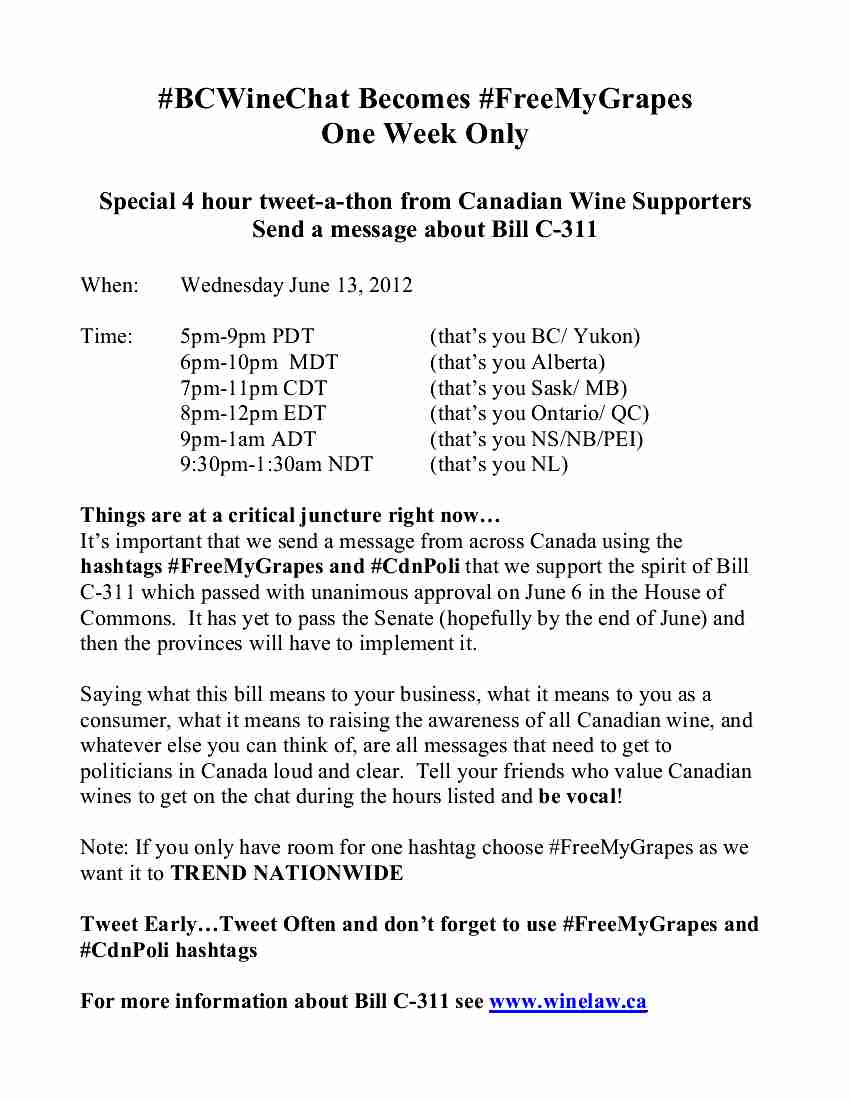
June 13, 2012 5-9pm PST: Special #BCWineChat: #FreeMyGrapes

HERE’S HOW THE CHAT WENT:

SPECIAL BCWINECHAT: #FREEMYGRAPES 

Update: The 4 hour-long coast to coast #FreeMyGrapes chat did indeed trend on twitter in the following locations:

  • Canada
  • Toronto
  • Ottawa
  • Calgary
  • Vancouver
In 24 hours It generated 2,606,066 impressions reaching an audience of 506,703 people.  If we are looking to create a wine culture across Canada, this was a historic day–Canadian wine trended in Canada!

May 30 8-9pm PST: Interprovincial Wine Shipments: Bill C-311

HERE’S HOW THE CHAT WENT:

 INTERPROVINCIAL WINE SHIPMENTS: BILL C-311  May 30, 2012

Things are going so fast in the last couple days since Bill C-311 was stalled on the floor of the House of Commons on Tuesday.  Tonight we thought we would be talking about the BC Government’s response to passing 311 but instead we are going to discuss where the bill stands now and allow all of you to send a message–loud and clear–to Ottawa.  #freemygrapes and #BCWineChat are the hashtags folks.  Use them.

Forwarded Email from NDP MP Alex Atamanenko.  His speech yesterday in the House of Commons  RE: Bill C-311

“Courage is having the integrity to do the
right thing even if it means you stand alone.”Importation of Intoxicating Liquors Act
Private Members’ BusinessMay 29th, 2012 / 5:40 p.m.NDP
Alex Atamanenko British Columbia Southern Interior, BCMr. Speaker, I am happy to say a few words in support of Bill C-311. I would like to thank my colleague for Okanagan-Coquihalla for taking the initiative to introduce the bill.I know there is pressure to fast-track the bill through Parliament, and I understand that. However, it should be noted that this issue is not new. The Canadian Vintners Association has been requesting more flexibility in our liquor laws for a number of years.I became involved a few years ago. I wrote the minister on September 2010 and received a very favourable response. At the time, he mentioned that he was soliciting input from provinces and territories to enter into a consensus-building approach to explore the impact of the limitations in place under the act. Subsequently, we had more communication. It is my understanding that this was in the process.To those who say that we need to go very quickly, I understand that. However, we should put this in context: this issue has been under consideration for a while. Theoretically, the government could have introduced legislation long ago and resolved the issue. That did not happen and we are here today debating this important bill.Hopefully we can move it forward today. It would certainly be very appropriate if we could change this law before the summer tourist season.Why is this bill important?

First, it would allow consumers to buy a reasonable quantity of wine directly for personal consumption. The quantity would be defined by each province.

Let us not forget that it is illegal for me, for example, to go to a winery in Ontario, buy a bottle of wine there and take that bottle home with me to British Columbia. It is absurd.

This bill would also address the legal issues surrounding interprovincial wine tourism and would allow wineries to ship their products, including products ordered online, directly to customers in other provinces, according to the limits set by those provinces.

So to support this bill is to support choice for consumers. It would greatly benefit Canadians to have a wider choice of wines, particularly from small wineries all over Canada.

We must remember that the Canadian wine industry is beginning to make an international reputation for itself as a temperate zone wine producer. It has won an impressive number of awards and has earned the praise of a number of the world’s most influential countries in terms of wine appreciation.

Making this act more flexible would broaden the choice, while still maintaining the monopoly enjoyed by each province’s liquor board.

While I am here I will give a plug to our B.C. government liquor stores and their employees. It is my understanding that the passage of Bill C-311 will not in any way interfere with our provincial liquor boards to serve citizens in our communities. Our government liquor stores are first-class with a wide variety of products and employees who are knowledgeable and proud of what they do. We should also not forget that they play a major role, with their half-decent wages, in contributing to the economy, especially in our small communities. Good union jobs in our small communities are the best guarantee of the survival of a small business. Government liquor store employees contribute significantly to the economy of the communities in which they live and work.

It is important, especially for our small rural communities, for everyone to rally in support of retaining well-paying jobs. I have spoken with representatives of chambers of commerce and labour about the idea of presenting a united front the next time there are proposed government cutbacks that threaten our workers and the way of life in our small communities.

I thank the Canadian Vintners Association, the Canadian Chamber of Commerce and all the wineries in my riding, the riding of the member for Okanagan-Coquihalla, in Kelowna and right across the country. I have tasted fine wines in Ontario, too. These wineries have rallied in support of this legislation.

Hopefully very soon, ideally this summer, the summer tourists will be able to visit wineries in other provinces, buy a few bottles and take them home with them legally.

I thank my colleague from Okanagan-Coquihalla again for spearheading this important issue.
May 23 8-9pm PST: Corkage (Bring Your Own Bottle of Wine) to BC Restaurants

HERE’S HOW THE CHAT WENT:

CORKAGE (BRING YOUR OWN BOTTLE OF WINE) TO BC RESTAURANTS

In 2003 Alberta relaxed its liquor laws to allow for corkage–the ability for patrons to bring their own bottle of wine to participating restaurants, pay a pre-set corkage fee and open at their meal.  The following conditions apply (according to Alberta Gaming Liquor Control)

  • The licensee must post a schedule of corkage fees
  • The patron must hand over the wine to licensee staff immediately upon entering the premises
  • Licensee staff are responsible to bring the wine to the patron’s table, and to open and serve the wine.

When requested, all licensees are obligated to recork partially consumed bottles to be taken home by the customer. (Liquor Licensee Handbook 5.3.15 b).

A Wine Spectator survey in early 2011 showed that 25 of the 50 states in the US allowed for corkage–including our neighboring West Coast states of Washington, Oregon and California.

Why does British Columbia not allow for Corkage (or Bring Your Own Bottle of Wine) at BC restaurants yet?  What are the concerns from restaurants?  How have these concerns been addressed in other jurisdictions? Would allowing corkage help the wine culture in BC?

Join the chat on Wednesday for a certain fast-paced discussion.

May 9, 2012 8-9pm PST: BC Wine and Farmer’s Markets

HERE’S HOW THE CHAT WENT:

BC WINE AND FARMERS MARKETS May 9, 2012

Most people understand that wine comes from grapes or fruits.  Everyone understands that grapes are a crop–grown in the ground.  Why is it that 100% BC grown wines cannot be tasted at BC Farmer’s Markets–let alone sold at them?  There are other jurisdictions that allow wine to be sold at local Farmer’s Markets such as Oregon so it can be done, but what laws are preventing our local producers of BC wines from doing the same?

Should there be restrictions on pouring samples?  Should there be restrictions on which wines would be allowed into a local farmer’s market or should that be left up to the organizers of the individual farmer’s markets to decide?  is there even a desire for wineries to present their wines at Farmer’s markets?

It is the season where local produce is becoming available and that means it’s also a great time to discuss why this particular local agricultural product–WINE–is left not allowed into BC’s farmer’s markets.

April 11 8-9pm PST: Cellared in Canada

HERE’S HOW THE CHAT WENT:

CELLARED IN CANADA April 11, 2012

Come one!  Come all!  Time to talk Copper MoonJackson Triggs Proprietor’s SelectionLinden BayWild Horse CanyonSawmill CreekPainted TurtleNaked GrapeDomaine D’OrSchloss Laderheim and Similkameen Superior–to name a few.

Wines under the “Cellared in Canada” section of BC liquor stores are available at a lower price than other BC VQA wines. There is a place for wines under $10.  Other country’s lower priced exports are generally made from grapes grown in the export country, but in Canada there is not a lot of extra acreage available for growing grapes to satisfy this price category.  Therefore, commercial wineries are allowed to bring in grapes, juice or wine from outside of Canada, bottle it here and label it “Cellared in Canada”.

Specifically, the labels now generally read “Bottled in BC from Imported and Domestic Wines”.   In British Columbia this means that these wines MAY be produced from 100% foreign content.  In Ontario it means that these wines are produced with NO MORE THAN 60% foreign content (slated to change in 2014 to match BC’s rule so that it does not need to contain any Canadian wine).

How is it allowed that these wines can state on their back labels “Cellared in Canada from Imported AND Domestic Wines” when in BC they do not need any amount of BC content whatsoever? Do these wines fill a niche in Canada?  Producers of Cellared in Canada wines such as VINCOR, Peller Estates and Mission Hill maintain that this category of wines are responsible for a considerable number of jobs in the Canadian wine industry and that they allow Canadian wineries to compete in a category that VQA wines cannot satisfy.  Do these wines get any unfair advantages on wine lists and retail shelves that are not afforded to wines made from BC grown grapes?  Does the average consumer still believe that these wines are made from BC grapes? Should terms such as “Similkameen” be allowed on a product that contains no grapes from BC?

We’re looking for comments from all sectors on this #BCWineChat–BC wineries, retailers, restaurants and, of course, most importantly consumers.

February 22 8-9pm PST: What will the BC Wine Industry Look Like in 2017?

HERE’S HOW THE CHAT WENT:

WHAT WILL THE BC WINE INDUSTRY LOOK LIKE IN 2017?

Here’s a quick look back at the BC wine industry in the past few years: (most data courtesy the BC Wine Institute–thank you!)

  • There are 196 winery licenses in BC right now.  Five years ago that number was 134.
  •  In 2008 there were 9,100 acres of vineyards and only 4 years before that there was only 5,462acres. Today there are 710 vineyards (both winery owned and independent growers)
  • Per capita consumption of wine in BC is 15.9 liters per annum (average for Canada is 13.1 liters) with British Columbians drinking 49% white v 51% red wines (via Statistics Canada)
  • In 2010 BC VQA wines sold for an average of $17.54 per bottle whereas five years before in 2005 the average price was $15.47
  • The Liquor Control and Licensing Branch of BC website says they are not accepting applications at this time for new licensee liquor stores or for off-site retail wine stores.

Where will we be in 5 years?  Will we see our industry contract, gradually expand or boom?  Will British Columbians still be paying the prices they are for BC wines or will they look elsewhere for better value?  Will there be more or less wine shops in BC?  This is one hour of imagination–where will our industry be 5 years from now?

January 11 8-9pm PST: BCLDB and Licensing Regulations for BC Wineries

HERE IS HOW THE CHAT WENT:

BCLDB AND LICENSING REGULATIONS FOR BC WINERIES January 11, 2012

Many policies and regulations govern those who hold winery licenses in BC.  The Terms and Conditions for Winery Licenses in BC show some of these, but there are also interpretations of what are stated here as policies.

In addition there is the Liquor Distribution Act which gives the Liquor Distribution Branch (LDB) the sole right to purchase beverage alcohol both within BC and from outside the province, in accordance with the federal Importation of Intoxicating Liquors Act.

December 28 8-9pm PST: BC Wine Resolutions for 2012

HERE IS HOW THE CHAT WENT:

BC Wine Chat: BC Wine  Resolutions

Tell us what your BC Wine Resolution for 2012 is:

  • Is there a BC wine you’ve always wanted to try but for some reason (availability, price, etc) you have never had?
  • Maybe there is a BC wine touring region you have been itching to see
  • A government regulation or two you’d like to work at seeing eliminated
  • You want to expand your knowledge of BC wines and don’t know where to start.
  • You’re looking to change careers into, out of or within the BC wine industry

If you enjoy it.  If you grow it.  If you make it.  If you sell it.  This is the chat for you.

December 21 8-9pm PST: Interprovincial Wine Shipments in Canada

HERE IS HOW THE CHAT WENT:

INTERPROVINCIAL WINE SHIPMENTS IN CANADA December 21, 2011

POST CHAT UPDATE:

Here is a SAMPLE LETTER you can send to your MP to show support for Federal Bill C-311, and here is the address of your Member of Parliament in Ottawa.  This bill was introduced by MP Dan Albas of Okanagan-Coquihalla (@danalbas)  Now is the time to show the Federal government that it is important that Canadians have better access to Candian-made wines!

Background information on this topic can be found throughout Mark Hicken’s site winelaw.ca.   There has been a tremendous amount of activity on this topic in Ottawa lately with the introduction of Bill C-311.  An overview of the 1928 law that governs interprovincial wine shipments in Canada can be read here.

Additional information is found on the www.freemygrapes.ca.  This site includes great links and information and tells you how you can support amending our archaic liquor laws.